Golden Gate Wooden Boat Foundation — keeping historic wooden yachts sailing on San Francisco Bay
We keep wooden boats sailing. The Foundation preserves, restores, and actively sails historic wooden yachts of significance to San Francisco Bay — and pays the boatwrights, riggers, and sailors who carry the craft forward. We are volunteer-run; nobody here takes a salary. The work is funded phase by phase and published as it happens, setbacks included.
Alongside the boats we are building a library of online resources: the Wooden Boat Atlas, a cited reference to the designers, builders, yards, and classes of the wooden boat era, and the Maritime Glossary, a working sailor’s vocabulary from the age of sail to the modern cockpit. Free to read, licensed to share.
Current project: yankee2026.org →
Boats are best preserved through use.
Traditional wooden yachts belong under sail, in motion, and in capable hands — not behind ropes. There is no exhibit here, no interpretive center, no velvet stanchion between the visitor and the varnish. There is a boat, a yard, and skilled work being done well, in the open, where anyone who cares to look can watch it happen.
The mission is narrow by design. A focused organization is a durable one: it does a few things, does them in public, and measures itself by a standard anyone can check. In plain language, the work is this.
- Take on boats with a claim on this Bay. Wooden yachts with a documented connection to San Francisco Bay’s maritime history — through their builder, their racing record, or their design lineage. The threshold is not age. It is significance.
- Put them back in sailing condition, traditionally. Using the methods the boats were built with and the people who still know them. The Bay still holds working yards, a school of traditional boatbuilding, and independent artisans; we contract the right hands for each project and pay them properly.
- Then actually sail them. Restored, for us, means crewed, insured, berthed, and racing. A boat that sits gets inspected occasionally. A boat that sails gets inspected constantly, by people who will be aboard when something fails.
- Publish all of it — including the setbacks. Costs, decisions, surveys, and the things that go wrong. When we do not know a number yet, we say so and publish it when it is in hand.
If you care whether these boats survive as sailing vessels rather than as photographs, this is the organization to watch.
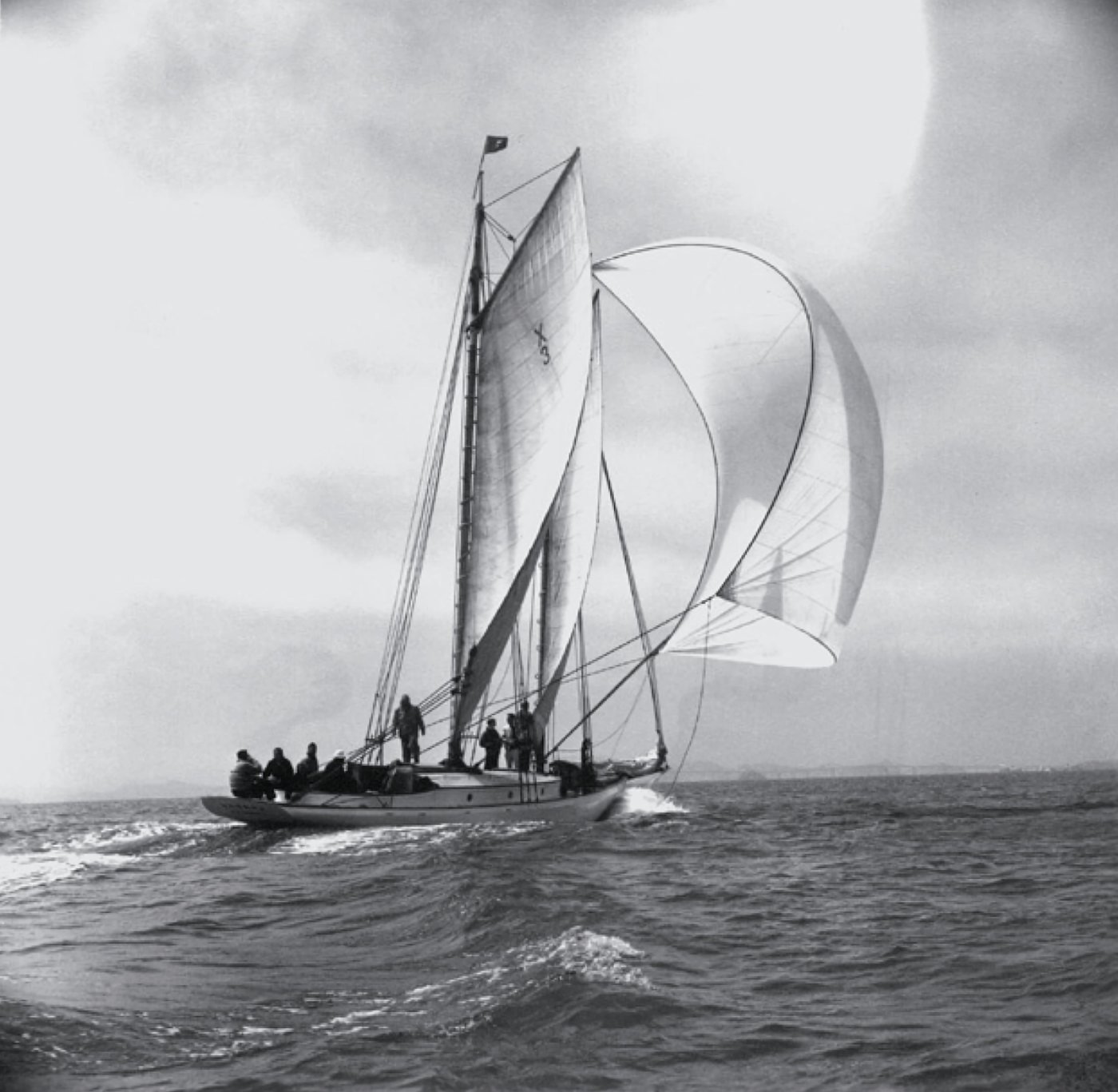
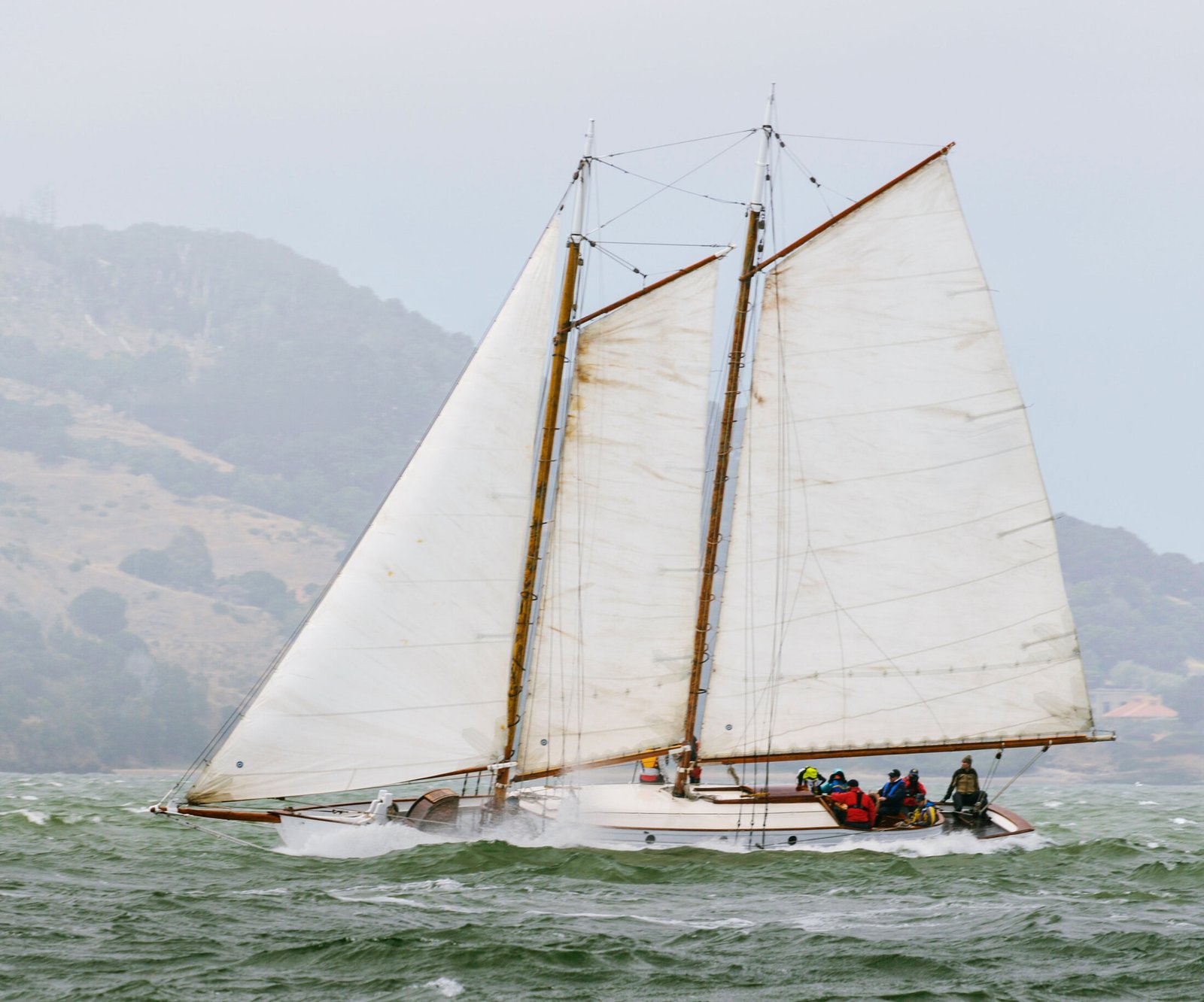
Yankee, 1906.
July 2026 · Phase 1 of 10 · Funded · Under way
Yankee is a 52-foot gaff schooner, drawn by Frank Stone in 1905 and sailing San Francisco Bay since 1906 — no winches then, none now. Ocean-race winner in 1907, Navy patrol vessel in the Second World War, St. Francis Yacht Club flagship seven times, champion again as recently as 2015. She is the oldest Stone-built vessel still sailing the Bay, and the Foundation took stewardship of her in her 120th year.
The hardest structural work is done. What remains is organized as ten phases with separate scopes and budgets, an estimated $160,000 to $255,000 in all. For this restoration we have engaged Richardson Bay Boatworks, a third-generation family yard in Sausalito.
Every restoration is a payroll and a classroom.
San Francisco Bay once built ships. Stone’s yard at Harbor View launched racing yachts, steam tugs, and five-masted schooners from ground that is now the Marina District; Sausalito, Alameda, and the City’s own waterfront held dozens more. That industry is gone. What survives is a small number of people who can still loft a hull, steam a frame, hang a plank, and set up a traditional rig.
They are not concentrated in one place. The craft lives across the Bay in family yards, in a school of traditional boatbuilding, in maritime institutions, and in the toolboxes of independent boatwrights, riggers, and sailmakers who move from job to job. What that whole economy needs is not another museum. It needs paying work on real boats.
That is the Foundation’s role: to be a steady, well-documented client of the Bay’s traditional maritime trades — engaging the right yard and the right hands for each project, paying properly, and publishing the work so the public can watch the craft being practiced.
- The skills pass by apprenticeship. Parent to child, master to apprentice, on deadline, on real boats. They cannot be transmitted by exhibit — only by funded work.
- No house yard, no exclusive hands. We choose the yard and the artisans project by project, under written contract, at fair rates. The mission is the craft economy, not any one shop.
- Documentation is part of the job. Photography, writing, and open books travel with every engagement. The public sees the work; the trades get the credit.
A gift to this Foundation is a wage paid to a skilled person practicing a demanding craft. We would rather state that plainly than dress it up.
Where the money goes.
The Foundation is entirely volunteer-run. There is no payroll, no office, and no administrative overhead in the usual sense. Four facts about the money, stated plainly.
- Nobody here takes a salary. Not the directors, not the officers, not the volunteers. Every dollar received buys boatwright hours, materials, marine survey and engineering, hauling, berthing, insurance, and the photography and writing that keep the work visible.
- Work is funded one phase at a time. Each phase has its own scope, its own budget, and a published result. A gift is not absorbed into general operations — it is spent on a specific piece of work you can go and look at.
- Unknown numbers are called unknown. The survey sets the scope and price of the next phase. Until we have that figure we do not estimate it in public, and when we have it we publish it.
- Designated gifts stay designated. A gift earmarked for a particular boat is legally binding on us and is tracked separately in the books. We also accept cash, securities, materials, and — with board review and a marine survey — vessels.
If you want a wooden boat sailing on this Bay, fund the next phase of the work.
The Wooden Boat Atlas.
A reference atlas of the people who designed and built wooden boats — organized by era, region, type and class, designer, builder, and institution. It is deep on San Francisco Bay, which produced its own designers, yards, and one-design classes, and it reaches outward from there. Every claim carries its source; where sources disagree, both readings are recorded; open questions are flagged rather than guessed at. Free to read, licensed to share (CC BY-SA 4.0), improved by correction.
The Maritime Glossary.
A sailor’s vocabulary: several hundred maritime terms, modern cockpit language alongside the archaic vocabulary of the age of sail — sails and rigging, hull structure, navigation and weather, knots and ropework, crew roles, signals, and the traditions of life under sail. Each entry reviewed against Admiral W. H. Smyth’s Sailor’s Word-Book (1867) and other standard references. Browse, search, filter — or take the quiz and see how many you actually know.
A volunteer board, at the helm.
Six directors with direct experience in wooden boat restoration, Bay sailing, and nonprofit stewardship. No one involved takes any payment or salary.
The Foundation operates as a program of the West Coast Seafaring Society, a California 501(c)(3) public benefit corporation that holds title to the vessels, the EIN, insurance, and the bank accounts.
| Legal entity | West Coast Seafaring Society, a California 501(c)(3) |
|---|---|
| EIN | 84-1776838 |
| Program | Golden Gate Wooden Boat Foundation |
| Compensation | None. No director, officer, or volunteer is paid. |
Get in touch.
For giving, governance, vessel proposals, press, or anything else: info@ggwbf.org.
If you have a wooden boat with a claim on this Bay’s history and you are wondering what happens to her next, that is exactly the conversation to start.