What we take on.
Not every old wooden boat is a Foundation project. The criteria below are the ones the board applies, and they are published so that anyone considering placing a vessel with us knows the standard before the conversation starts.
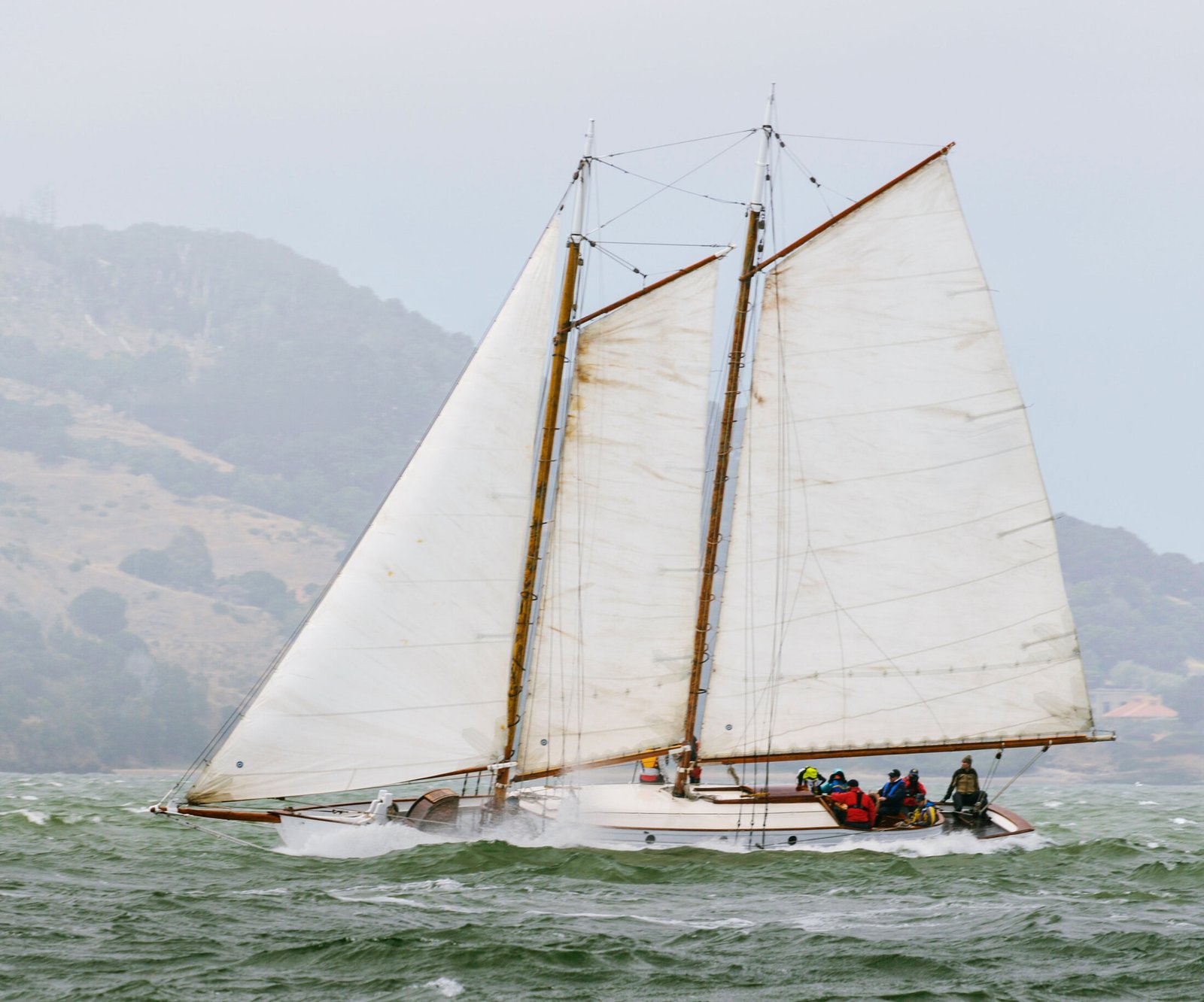
Yankee, 1906.
July 2026 · Phase 1 of 10 · Funded · Under way
Status. Richardson Bay Boatworks, Sausalito. Phase 1 of 10 under way: haul-out, survey, stabilization. Funded. On hand at the yard: 1,000+ board feet air-dried Douglas fir, cap rails, hardware. In private storage: eight refinished spars; a complete new suit of North Sails. Next milestone: the survey prices Phase 2.
Drawn by William Frank Stone in 1905 for David Abecassis, who wanted a boat that could win on this Bay, and built at Stone’s Harbor View yard. The April 1906 earthquake threw her from her building cradle weeks before completion; she was finished and afloat that spring. She won her first race that season and the first ocean race sailed out of the Golden Gate the year after. She has sailed this Bay for 120 years: Navy coastal patrol in the Second World War, flagship of the St. Francis Yacht Club seven times, championship winner as recently as 2015, and to this day without a winch aboard. She is the oldest Stone-built vessel still sailing the Bay.
The most demanding structural work — frames, stem, forward planking — was completed before the pandemic paused the project; the hull is watertight. What remains is verification, completion, and reassembly, in ten phases at an estimated $160,000 to $255,000 in all. For this restoration the Foundation has engaged Richardson Bay Boatworks, a third-generation family yard in Sausalito; the yard’s story is told on the project site.
What makes a boat a Foundation project.
Historical significance to San Francisco Bay
A documented connection to the Bay’s maritime history — through her builder, her racing record, her role in Bay culture, or her design lineage. The threshold is not age; it is significance. A mass-produced fiberglass sailboat is not a candidate. A Stone-built schooner with a century of Bay racing history is.
Feasibility
The project must be achievable in a reasonable time and budget. We commission a marine survey before committing to anything, and we weigh cost against the Foundation’s actual capacity. The guiding principle is completion, not rescue: we favor boats where the hardest structural work is done or clearly achievable over speculative recovery from severe neglect.
A path back to sailing
The goal is not static preservation. A qualifying project ends with a vessel that can be sailed, raced, and used. She must be sound enough to return to service, and there must be a credible plan for crew, maintenance, and berthing once she is.
Board approval
Every project is approved by a majority vote of the board on a written proposal: scope of work, budget by phase, timeline, the yard or lead craftsperson, and an honest assessment of risk — including the realistic worst case and what we would do about it.
If you have a boat.
Owners reach this decision in different ways: an estate, a move, a health change, or the slow arithmetic of a boat that costs more each year than the year before. It is not a comfortable conversation to start, and we would rather you start it early than late — the earlier a boat comes to us, the more of her survives.
What to send to info@ggwbf.org: the vessel’s name, designer, builder, and year; her current location and condition; any survey within the last five years; what you know of her history on this Bay; and what you are hoping happens next.
What follows: an initial conversation, a marine survey if the boat clears the first review, a written project proposal, and a board vote. We will tell you plainly if she is not a fit for us, and where else to try. A donated vessel carries real obligations — storage, environmental liability, insurance, title — and accepting one we cannot finish would serve neither the boat nor the donors already funding work.
If the alternative on the table is a dumpster, call us first.
The register.
Beyond our own projects, we intend to publish a register of significant wooden yachts on San Francisco Bay: what they are, who drew and built them, where they are now, and what condition they are in. Much of that record exists only in individual memory, and it is being lost at the rate you would expect.
The groundwork is already public: the Wooden Boat Atlas, the Foundation’s atlas of the designers, builders, and classes behind these boats, already carries the designers, builders, classes, and yards behind the Bay’s wooden fleet, and the structure a vessel register will hang from.
If you hold records, photographs, or drawings of Bay-built wooden yachts, we would like to hear from you.